2011/07/05

[Japanese Moderns] S2000, nice way to celebrate an anniversary


Bit boring for a sportscar, no?
Let's ride to another continent now, to Japan in fact. First shown as a concept car in 1995, Honda launched the S2000 roadster in 1999 to celebrate the 50th anniversary of the company. The S2000 was name according to its 2L engine. The original S2000 was introduced with a 237 hp VTEC 4 cylinder engine, working with a 6-speed manual transmission and a Torsten limited slip differential. This roadster was reputed to be really hard to drive on normal roads : its VTEC engine was only delivering its power on very high RPM, such as 8000 or 9000, just like a moto. The sound of the car was actually just like Honda's moto.

Type S Version.

In 2004, several improvements were introduced to the car, especially a new suspension and lower RPM rate for the acceleration. The redline was lowered to 8200 rpm. A sportier model (Type S) was also introduced in Japan, using an aluminium hard-top and aggressive skirts. The car has been fairly popular until 2006, but then the sales started to fall down (essentially because of the car being older and hard competition of newer Mercedes SLK and BMW Z4). The 2008 USA car market crisis literally killed the car, with only 2500 units sold in all the year (74% decline), so the production ceased in 2009, and the replacement project was cancelled. It will surely become a classic in the years to come.

Any diecasts of the S2000?


Of course! First i got is a Maisto regular line one. Maisto's aren't recognized to do high quality diecasts in their regular line, but this one isn't that bad. I must say, tampos would have been nice, side mirrors are needed and the big plastic window looks really cheap, but in overall, it looks like the real car. It's a good add to a collection without paying big bucks for a AutoArt for example.

In the 2011 casting line, Hot Wheels released a tuned version of the S2000 that is really well done. With a wide body kit, huge spoiler, sporty rims and a flashy yellow color, it looks really great! The overall form of the car is well reroduced too. It was designed by Matchbox's member Ryu Asada. It makes me remember the black S2000 of the first Fast and Furious movie, and fits well in any collection too. The yellow line on the black rims really add a nice touch.

Enjoy the pics!

2011/07/02

[American Classics] AMC(s)!


Almost everybody knows that the three big American car makers are Chrysler, Ford and GM. But from 1954 to 1987, there was another american big one : American Motors Corporation, usually known as AMC. Created in 1954 from the fusion of Nash and Hudson, AMC written a page of the american car history, especially by developing the Jeep brand. Unfortunately, competition of the "Big Three" had been hard for AMC. The brand has been bought in 1979 by the french giant Renault, before being sold to Chrysler in 1987. Only the Jeep and Eagle names survived to this last sale.

Strange fact : the name AMC had been adopted as the official name only in 1970. From 1954 to 1958, Nash and Hudson were still used. Then, from 1959 to 1969, the name Rambler was used for the big sedans the company was producing. The Nash name survived until 1962, with the small Nash Metropolitan. AMC is recognized as the first american company to promote "small cars", thing that maybe saved the company in 70s, in the petrol crisis. Unfortunately, it also caused company's death, since when the crisis stopped in 1985, Americans wanted to buy big cars again, and AMC only had compacts and intermediates to propose.

AMC is neglicted in the diecast world, but there's still a few interesting ones, mainly from the 70's. I wish we would had some 80's AMC sometime...

Record-breaking, original one : AMC AMX


The AMX, standing for American Motors eXperimental, was one of the most original american cars of its time. Only produced from 1968 to 1970, it was described as a muscle car, but because of its short wheelbase, it was only compared to the Corvette. It was also the only 2-seater steel-bodied car of its time (previous one was the Ford Thunderbird). The AMX had also been recognized has the "Best Engineered Car of The Year" for two consecutive years, 1969 and 1970. Interesting fact, the original ad campaign in 1968 for the launch of the car was in cooperation with Playboy Entreprises.

There were lots of engines offered, from V8 225hp to 315hp big V8 block. In 1969, the Super Stock AMX has been introduced, offering a 420 hp, able to do a 10.73 seconds on the quartermile. It didnt even have a heater, but it was a true performance car.  Two specially prepared AMX were able to do some new high speed and endurance records at Texas's Goodyear race track. Officially, the car reached an astonishing 304 km/h, but the driver affirmed that he was able to push the car over 322 km/h. Those AMX were pieces of art.

The Johnny Lightning diecast replica i own is painted with the legendary colors of those two record-breaking AMX : White, Blue and Red. Released in 2005, as usual, JL did an awesome job with the car. It really feels the overall look. With the opening hood, you can even take a look at the terrific engine of this beast!

AMX as a Javelin extension


The AMX evolved as a performance extension of the AMC Javelin in 1971. It became a 4-seater, but was still a high performance car. The Javelin AMX offered multiple racing packages for the car enthusiast, such as the "Go Package" , with the choice of a 360 or 401 cu engine. The 1972 Javelin broke record sales for AMC, but never reached numbers as high as the competition (big names were in there, like the Mustand and the Camaro).

In 1974, the car market was changing a lot, and there was no more place for cars such as the Javelin AMX, mainly because of the petrol crisis. Cars were going smaller, and AMC needed place to build its new Pacer. Nowadays, the Javelin AMX is really prized among collectors and can reach astonishing prices. Originally introduced in 2009 as a new casting in the Hot Wheels regular line, the Javelin i own is the 2010 regular one. Designed with the AMC racing colors (red, white and blue again), it shows a really aggressive look.


Casting's well made, but Hot Wheels's quality is never as high as a JL one (i'm talking of the regular line here, the HW Garage serie is pretty good). Colors are pretty well chosen though, but more details on the body would have been appreciated, as well as tampos. It's still a pretty nice add to any collection.

First American compact car : Gremlin's introduction


The AMC Gremlin has been introduced in 1970, and is recognized as the first American subcompact-car (even if the Crosley and the Nash Metropolitan has been there before). Competing with the six-months later released Ford Pinto and Chevrolet Vega, it was also designed to compete with the legendary Volkswagen Beetle. In my humble opinion, the Gremlin's obviously one of the ugliest American car produced...


The Gremling was described as a stable and comfortable ride... for the front passengers. Of course, with the car being so small, the two rear seats were reserved for children. Competing with the VW Beetle, it had a style immediately recognizable in the streets. The car has really been popular from 70 to 74, but an inflatory economy put a hard shot at the sales in 1975, and they declined until 1978. As the Pacer was introduced in 1975 too, it was already over for the Gremlin. Over 8 years, AMC often offered Volkswagen engines under the hood of this special car. The Gremlin has even been used as a dragstrip racing car, or to experiment hydrogen or electric engines.


Offered in 2006 by Johnny Lightning, the diecast is simply awesome. The pale yellow gives it a real oldtimer look, and the overall car is awesomely reproduced. It's truly one of my favorite pieces of my collection. Even though the car is fugly, its unique style gives it a special feeling. Yellow wheels add a nice touch. Only thing missing is the side mirrors!

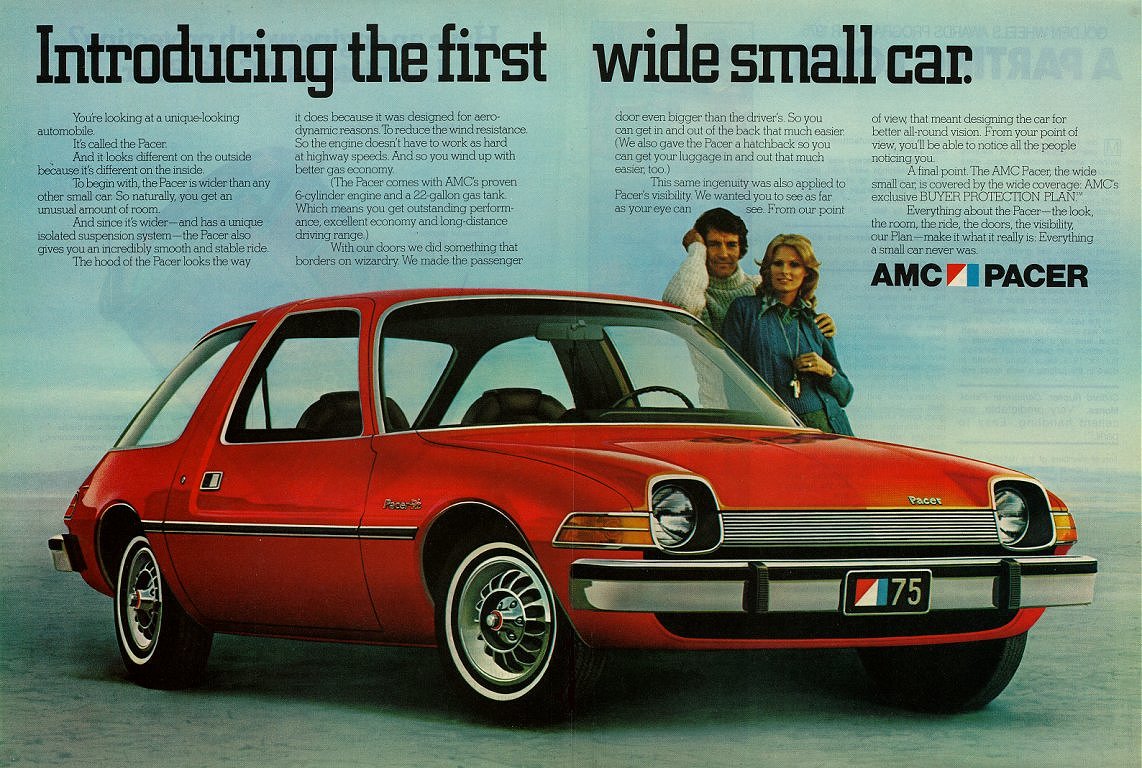
AMC Pacer, nicknamed "The Aquarium"


The Pacer is certainly one of the most iconic cars of the late 70's. Contrasting with the boxy design used in those years, the Pacer offered a controversial rounded, fully glassed style. Even more original, during the development of the car, it was supposed to be equipped with a Wankel rotary engine produced by GM. Just before the release, in 1974, GM decided to stop developing the engine (durability issue), and it left the Pacer with a straight 6-line cylinder flat engine for its 1975 introduction.

The car received a lot of criticism, good or bad. Some described it as the "car of the future", others said it was the ugliest car ever made. For those years, it was surely original. It was designed as an alternative to the huge American cars, in years where the petrol was about to become really expensive. It sold well for the first 2 years, but after 1977, the Japanese competition along with a few reliability problems killed the Pacer's career. It disappeared in the year 1979. A lot of variants had been offered, such as the Wagon or the Pacer X (sporty version). Even an electric Pacer has been produced, but at a starting price of 12 000$, it was SO expensive!


The nickname Aquarium came from my father, who was working in an AMC/Jeep garage in these years. The big glasses got a problem : they weren't so well sealed, so they had a lot of cases of water infiltrating the car... then they gave it that name.

Talking diecast, i have a nice replica of a 1977 Pacer X made by Johnny Lightning. The front of the casting is a bit off imo, but it's nice overall... it got a "cheap" look though. Tires are great! Side mirrors would have been a nice add.. i think i would have prefered the brown Classic Gold serie one, but that yellow Pacer is still a must for any car collector.

Enjoy the pics!

[American Classics] Chevelle continued....

Sometimes i'm so lucky... last evening, went to the Quebec City Old Quarter to have a little drink, and i stopped by a small "souvenir" shop... and found something really interesting : a new Chevelle! Just in time to add a little stuff to my last article...


So, the model i found is a 1965 Chevrolet Chevelle SS by Johnny Lightning. Originally released as a Police Car in the 40th Anniversary line, it has been transformed into a normal car for the further releases. Strangely, the #974 casting is identified as a Chevrolet Malibu, but it's well written on the box : Chevelle SS, as well as under the car... oh well! The Malibu and Chevelle were almost identical cars in those years. The edition i found is the yellow Forever 64 release, issued in 2010. As usual with JL cars, casting is awesome, really nice detailed. Side mirrors are missing, but that's not that important when you see the overall awesome effort put in the casting.


Strange thing, why are the headlights black? Oh, and i love the wheels. Enjoy the pics!

2011/07/01

[American Classics] Chevelle : One of the most successful Chevy

The original 1964 Chevelle. Quite looking like an Impala.

The Chevrolet Chevelle is one of the most popular Chevy in the history. Originally introduced in 1964 to compete with the unreachable Ford Fairlane, the Chevelle also had the goal to replace the original 55-57 Chevrolet Bel Air. In all its history (1964 to 1977), the Chevelle has been offered in multiple forms : hardtops and convertibles, 4-door sedans and even station wagons. Even 4-door hardtops and 2-door station wagons have been available in some years! Only the second generation will be covered in this article (from 1967 to 1972) since i only have diecasts from this generation.

Second generation : Power and pride

67's Chevelle SS396. Started an era of muscle car.


A few words about the first generation : there was a powerful version called the Chevelle SS396, powered by a V8 of 375 hp. In 1967, only 612 of these were built, and Hot Wheels made a great replica of this rare muscle car. First offered as a 2010 new model, the casting reproduces well the overall form of the car. I do have the first color offered, name Metallic Maroon. Side mirrors are missing, but i particularly love the hood details. A few tampos could have been added for the lights though instead of this metallic plastic.

Talking about the real car now, the second generation has been introduced in 1968, with a new body and multiples forms. The 69 Chevelle has been tagged as "America's most popular mid-sized car". It had a convenient style and a large variety of engines to satisfy every customer. In fact, it went from a standard L6 of 230 cube inches to a monstrous V8 454 Big Block. The Chevelle were offering advanced options for those years, such as headlight washers, power windows and locks , as well as a rear defroster.

69 Chevelle SS396.


More than 86000 units were produced with the SS396 option, and the 1969 Chevelle made by Hot Wheels is a great replica of this powerful option. First offered as a 2008 new model, it's made as a lowrider car. I have, in my opinion, the coolest of all made : the 2009 green Muscle Mania version. Side mirrors are missing again and the chrome plastic is a bit cheap, but it has great tampos and really feel the lowrider look.


In 1970, the Chevelle had been revised as a more square-up body. Engine range was even more bigger, from a basic 155 hp to a racing 500 hp big block. GM added Coil Induction to their SS engines, and it became one of the most powerful muscle car of the 1970 year. In fact, the 1970 Chevelle is probably recognized as the cooler Chevelle in the car's history. The Hot Wheels version came out in 1999 in a blue tone with white stripes. About all those Chevelle SS got stripes in these years. This is a well-done diecast for the overall form, but tampos are missing as well as side mirrors. It was one of my favorites as a children though, and i played a lot with it... mine is still in good condition though.

71 Chevelle SS. First model with only 2 front lights.


In 1971, the Chevelle received a small face-lift, but putting out the original 4 front lights. In diecast, Matchbox created a nice replica of the Convertible version of the 71 Chevelle. This model is somewhat special : first offered in 2004 in the New Superfast Special serie, it has only been offered one time in the normal line : in 2008, with a somewhat dull blue color. I have the flashy 2010 yellow one, only offered in the Showroom Models 10-pack. Again, mirrors are missing as well as tampos, but colors are pretty nice and interior is really well made. A nice casting overall.

Beyond 1972, the third generation of Chevelle suffered a lot from the petrol crisis, and became slowly replaced by the Chevrolet Malibu, and the Chevelle name was officially dropped in 1978. Interesting note, the Chevelle had a small but brilliant career in the NASCAR races serie from 1973 to 1977.
76 Chevelle. The car was way uglier than the first ones.

I absolutely need more Chevelles!

2011/06/26

[Italian Classics] Countach's legend.


The Lamborghini Countach is certainly one of the most legendary Lamborghini. It has been listed by Sports Car International as the #3 of the Top Sports Cars of the 70s, and as #10 of the Top Sports Cars of the 80s. During its sixteen years of life (from 1974 to 1990), only 2500 cars were produced. It also popularized some sports cars trends still used today, such as the sharply angled look and the cabin-forward design concept. It has also been done many times in all scales of diecasts.

How it started
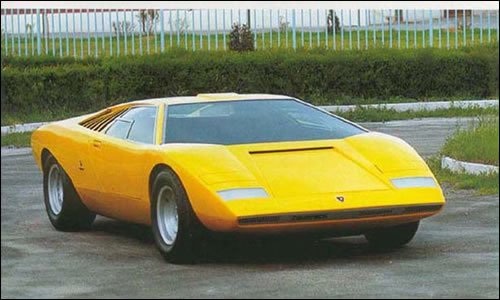
1971 Concept.

The name Countach is an exclamation of the Piedmontese language, generally used when a man see a beautiful woman. Designed by the legend Marcello Gandini of Bertone (designer of the legendary Miura), the Countach was a wide and not very long car. It is still recognized as the most outrageous Lamborghini designed in the history. Scissors doors were giving an astonishing effect. Main problem of the cas was its reliability... a thing that mainly improved in new Lambos (especially when Audi bought the brand.) The Countach uses a tubular space frame, as in the racing cars. It gave a small weight of only 1400 kg, mainly because of the fiberglass body.
The original LP400 one.

The first prototype of the Countach was the LP500: introduced in 1971 in the Geneva Motor Show. It even had NASA air-ducts on the side! The original Countach was sunflower yellow, but we often see red or silver color. The Countach entered in production with the code-name LP400 in 1974, with a 353 hp engine. It had a narrow front end, easily distinguable from the further series. Lamborghini only produced 158 units from 1974 to 1977.

In 1978, the LP400S was introduced. The most important changes were the common-see front and rear spoilers. Wider tires were also added at the back of the car. The car was renamad as LP500S in 1982, and the engine was upgraded to 4 liters to 5 liters. It's the most "common" Countach encountered. In 1985, the car was finally introduced in America, with a basic price of 100 000$ (that was a lot of money in those years!). The engine had been upgraded to 420 bhp, with the same original weight.
How can you resist to such a beautiful car?


Last Countach produced.
The final Countach was the one introduced in 1988, named the 25th Anniversary Edition. It is recognizable by its way more futuristic style, and its usual color was the flashy silver. Car has only been produced for 2 years, before being replaced by the Diablo in 1990.


Diecast time!

Of course, the best diecasts of Countach has been done by Kyosho or AutoArt, but eh, they're really expensive, and i prefer having less expensives diecasts, but at least have them! The older diecasts of Countach i have are the Majorettes one. Introduced in the 200 line as the number 237, the Majorette has mainly been produced as a racing Countach, but there's also a rarer stock black one. I had this one when i was a kid, but it was so much in bad state that i recently decided to restore it. I added a few details such as the front and back lights. I also tried to keep the original color, even if it's an odd color for a Countach. The green interior is a bit odd too... But it's an overall nice one.
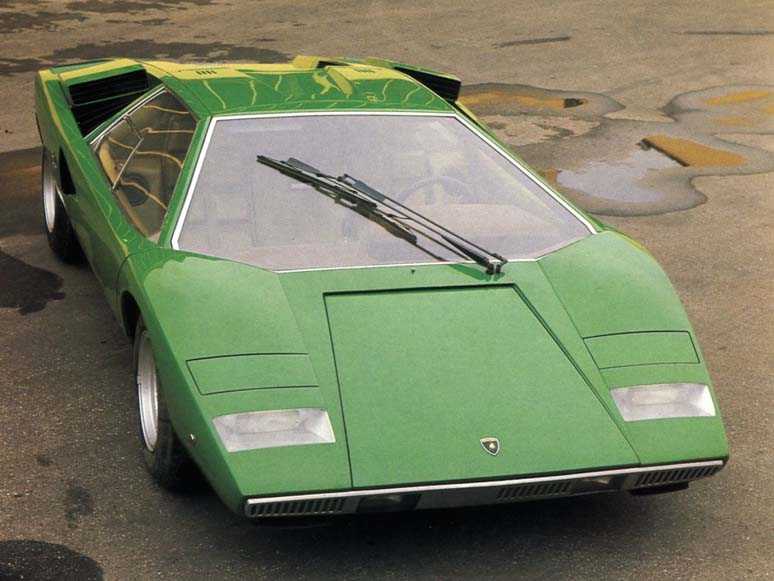
I bought the racing one last year in a big Majorette lot. I'm not a fan of this casting, as it is somekind unrealistic and with bad tampos. The rear spoiler is also horrible. That's more of a "for-kid" casting.


2 Majorettes together.

On the other hand, Matchbox made a LP500S replica in 1985, and it survived in the line until 2000. I have the red 1996 edition, and i must say it's a really well-done casting, even if some of those Tyco years Matchbox were awful. Tampos are missing and the wheels aren't a so-good fit with the car, but the overall feeling of the real one is really well reproduced. I have this one since i'm a kid, and i'll surely keep it.


The latest diecast i have is a replica of the 25th Anniversary edition offered by Hot Wheels in its Speed Wheels line last year. In my opinion, this is the definition of an awesome casting. Wheels, painting, the overall shape... it really looks like the original one. I was reluctant to buy it because i already had 2 Countach at this time, but tentation won when i saw how much it was well-done. Even tampos are high-quality.

Enjoy the pics! :)